
Decode Econ Educator Network
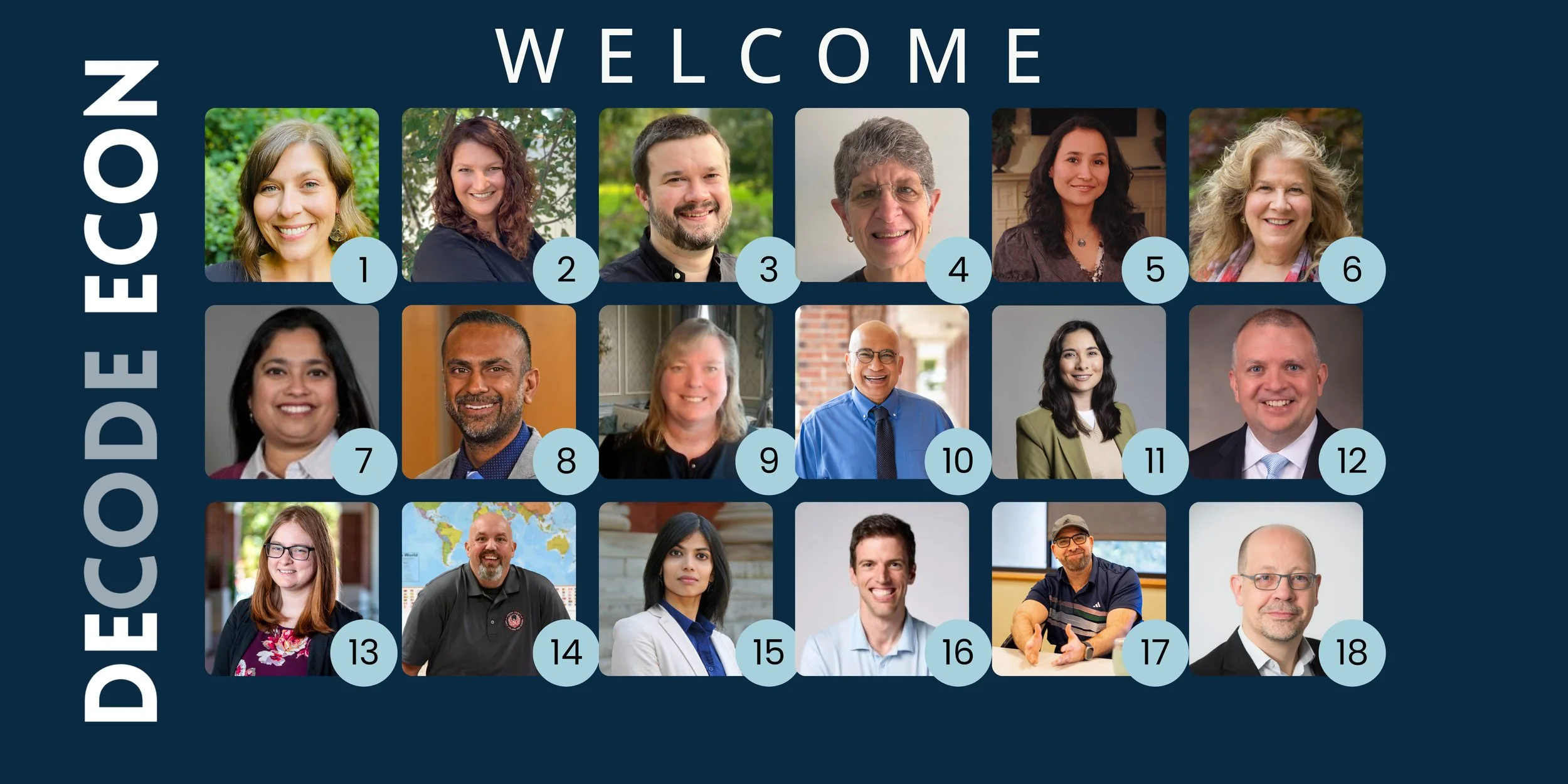
Announcing the Spring 2026 Decode Econ Educator Network
Decode Econ has grown quickly over the past year. What started as a set of articles and classroom-ready resources has become something bigger: a community of educators using economics to help students better understand the world they live in.
Regardless of the name, the work is already happening. We’re excited to share the faculty participating this year, educators actively integrating Decode Econ into their classrooms, helping students connect economic theory to real-world decision-making, and shaping the content you see at Decode Econ.
Participating Faculty
- Beth Munnich — University of Louisville
- Jennifer Davidson — University of Nebraska–Lincoln
- Christopher Roark — The University of North Carolina at Chapel Hill
- Audrey D. Kline — University of Louisville
- Vishakha Maskey — West Liberty University
- Susan Doty — The University of Texas at Tyler
- Asawari Deshmukh — University of Cincinnati
- Darshak Patel — University of Kentucky
- Linne Wienke — Southwestern College
- Varun Gupta — Wharton County Junior College
- Cecilia Cuellar — The University of Texas at Tyler
- Brooks Depro — Elon University
- Sarah King — Christopher Newport University
- Travis Towne — Lenoir County Early College High School
- Mallika Pung — University of Louisville
- Patrick Boor — Boston Latin School
- Sami Al Farhan — Northern Kentucky University
- Daam Van Reeth — KU Leuven
This group spans research universities, liberal arts colleges, community colleges, and high schools from across the world—exactly the range of perspectives Decode Econ was built to support.
Why Faculty Chose to Join
What stood out most in faculty responses was not a single tool or article, but a shared goal: making economics relevant, accessible, and meaningful to students’ everyday lives.
Connecting Economics to the Real World
“This spring, I’m launching a new introductory economics course designed to engage students by starting with real-world applications—examining how economists approach issues such as poverty, employment, health care, and housing. Decode Econ has been an invaluable resource for me, and my goal is to give students practical tools they can use beyond the semester.”
“I love Decode Econ and think it is a very helpful and important resource—not just for students, but for the public. We need to do a much better job tying economics to the everyday world.”
“Relevancy!”
Improving Student Engagement
“I wanted to provide more real-world applications—for myself and my colleagues—to increase student engagement through more relevant examples.”
“To enhance classroom engagement. I’ve subscribed and been using it for a year.”
Intentional Teaching Across Modalities
“I want to continue focusing on timely, real-world content. Participation in this program will help me be more intentional in my teaching—both in person and online—and help students see economics in their daily lives.”
“I use Decode Econ’s macroeconomic videos in my online classes and appreciate the way the content translates complex ideas clearly.”
Economics in Real Life
“It’s not an exaggeration to say Decode Econ has improved my teaching, and I want to take it to the next level.”
“My motivation stems from wanting relevant current-event articles that support student-centered discussion.”
Low-Burden, High-Impact Teaching
“Decode Econ provides an accessible bridge between theory and current events. This program is a low-burden, high-impact way to enhance student engagement while contributing feedback that benefits the broader economics education community.”
Building Economics Literacy
“I hope making economics more relevant can help recruit majors at our small school and strengthen economic literacy for non-majors.”
Shared Mission and Community
“I believe in this work, and I believe in you. This is our shared passion—to educate, motivate, and elevate teaching relevance and excellence.”
“I wholeheartedly support Decode Econ’s mission to make economics education more accessible and would love to help shape a meaningful way to teach economics.”
Why This Matters
I want to share why this matters to me personally.
Even though we stand in front of classrooms full of students every week, teaching can still feel surprisingly lonely. For a long time, I’ve wanted a community of educators I could lean into—people to learn from, think alongside, and build with. This feels like the first real step toward that.
My hope is that this community grows in ways that support not just Decode Econ, but other initiatives I care deeply about—like the Journal of Economics Teaching, connecting with faculty at conferences such as The Economics Games, the Conference on Teaching and Research in Economic Education (CTREE), and the Southern Economic Association’s economics education sessions.
I also see this platform as a way to expand what’s possible, make more classroom-ready resources available, experiment with new ideas, and, if we’re successful, collaborate on joint projects with groups like the Economic Education Network for Experiments.
At its core, the goal is simple: to build together.
And maybe, a year from now, that means some of these faculty members will join us at Haile to present their work through the Haile Research Lab. That would be a full-circle moment, and a sign that this community is doing exactly what it was meant to do.
A Final Note
Work like this doesn’t happen on its own. Building and sustaining a community, creating high-quality resources, and expanding access all require support.
If you’re interested in supporting Decode Econ—whether through partnership, collaboration, or resources—I’d love to hear from you. Your support helps us grow this community and increase the reach and impact of this initiative.
Together, we can do more.